
Sub-Total: £0.00
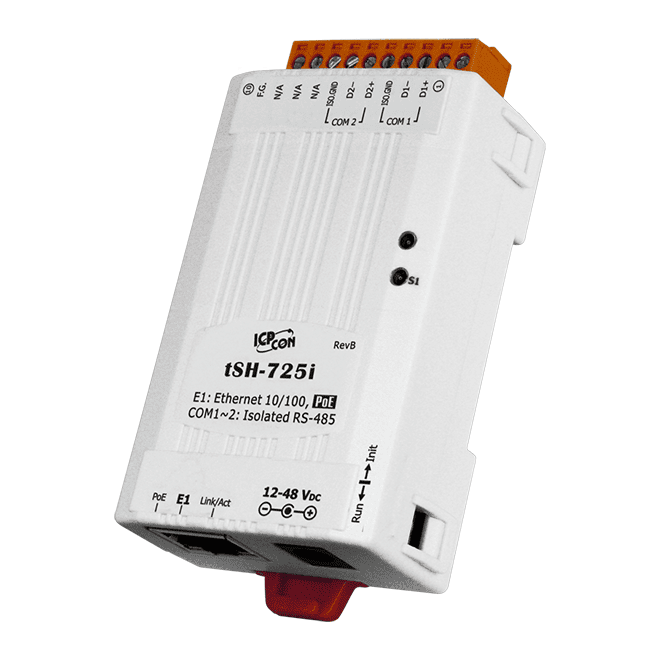
tSH-725i Tiny (2x Isolated RS-485) Serial Port Converter with PoE
Key Features
•Baud Rate conversion application
•Supports Modbus RTU/ASCII protocol conversion
•Raw data mode for most query-response protocols
•Built-in web server for easy configuration (HTTP)
•Redundant power inputs: PoE (IEEE 802.3af, Class 1) & DC jack
•3000 VDC Isolation and +/-4 kV ESD protection
•Tiny form-factor and low power consumption
•Read-cache ensures faster response


£130.50
Description
The ICP DAS tSH-700 module is a serial port sharer/converter that provides a number of functions, including “Baud Rate Conversion”, “Modbus RTU/ASCII Conversion”, “Two Masters Share One Slave” and “Read-Cache Function”. The built-in web server provides easy configuration interface, and no console commands are required.
Baud Rate Conversion: This function allows a single master device to communicate with slave devices using different baud rates and data formats.
Modbus RTU/ASCII Conversion: This function allows a single Modbus RTU/ASCII master device to communicate with Modbus RTU/ASCII slave devices using different protocols, baud rates and data formats.
Two Masters Share One Slave(for tSH-73x Series only): This function allows two master devices connected to different serial ports to share slave devices.
Read-Cache Function: The built-in cache function reduces the loading of serial communication on the slave port by removing duplicated queries when the two master devices are requesting the same information.
Baud Rate Conversion: This function allows a single master device to communicate with slave devices using different baud rates and data formats.
Modbus RTU/ASCII Conversion: This function allows a single Modbus RTU/ASCII master device to communicate with Modbus RTU/ASCII slave devices using different protocols, baud rates and data formats.
Two Masters Share One Slave(for tSH-73x Series only): This function allows two master devices connected to different serial ports to share slave devices.
Read-Cache Function: The built-in cache function reduces the loading of serial communication on the slave port by removing duplicated queries when the two master devices are requesting the same information.